



The grind is the quiet half of a great cup. The same beans can taste rich and smooth or bitter and thin, depending on how fine they're ground and how long they spend with the water. The foundational building block for a great cup (besides great beans) is matching the grind to your brewing method.
All our pre-ground coffees are a medium grind that's perfect for an auto drip brewer. If you plan to brew another way, we recommend whole bean coffee ground at home. It's the freshest that way anyway!
Step One: Know your brewing method
Your brewing method determines how the water interacts with the coffee, and the goal is to avoid over-extracting or under-extracting.
Over-extraction happens when the coffee is ground too fine for the method. For instance, a fine espresso grind in a French press makes a bitter cup: the coffee sits in hot water for several minutes behind a mesh filter, so it needs a coarse grind.
Under-extraction happens when the grind is too coarse, for example in an auto-brewer or espresso machine. The result tastes weak or sour. Generally, the faster the brewing method, the finer the grind, because the water has less time to pull flavor from the coffee.
Step Two: Find the right grind
For consistency, we recommend a burr grinder like the Baratza Vario W+ Grinder. Most burr grinders have settings from fine to coarse. With a blade grinder, timing is what controls the grind, so we've included approximate times below.
| Brewing method | Grind | What it looks like | Blade grinder (approx.) |
|---|---|---|---|
| Espresso machine | Fine | Table salt to powdered sugar | 15 seconds |
| Cone-shaped filters (pour over cones) | Fine | Table salt | 15 seconds |
| Automatic drip / flat-bottom filters | Medium | Sand | 10 seconds |
| Pour over | Medium-coarse | Coarse sand | 6 seconds |
| French press | Coarse | Sea salt | 5 seconds |
| Cold brew | Coarse | Sea salt | 5 seconds |
| Bean-to-Brew machine | Handled for you | Ground fresh by the built-in burr grinder | Not needed |
Burr vs. blade: why it matters
A blade grinder chops beans unevenly, so some pieces over-extract (bitter) while others under-extract (sour). A burr grinder crushes beans between two surfaces to one consistent size, so every particle brews at the same rate. That consistency is why we recommend burr grinders.
Grind it fresh
Once coffee is ground, far more of it is exposed to air, and its aroma starts to fade. Buy whole beans, store them well (see How to Properly Store Your Coffee), and grind right before you brew.
Step Three: Enjoy and taste the difference
We can't say enough about how much the right grind matters. Once your grind matches your brewing method, you'll be rewarded with a smooth, full-bodied cup time and time again.
Want to skip the grinder?
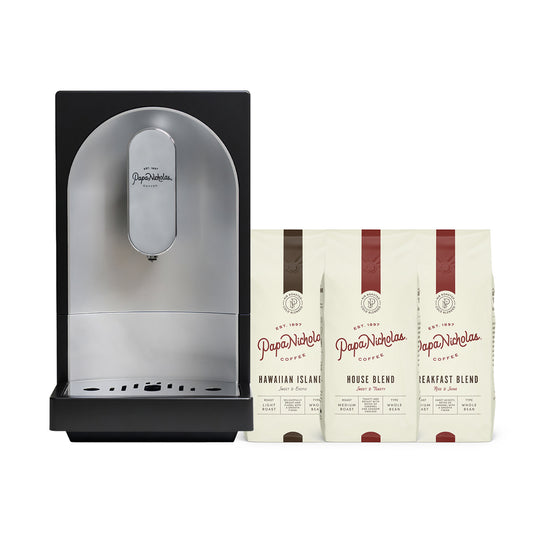
For espresso and single cups, our Bean-to-Brew Espresso & Coffee Machine has a built-in stainless-steel burr grinder. It grinds whole beans right before brewing and makes a 2 oz espresso or a 6 or 8 oz coffee at the touch of a button.
Grinding FAQ
What grind is best for a French press?
Coarse, about the size of sea salt. A finer grind slips through the mesh filter and over-extracts, making the coffee bitter and gritty.
Can I use an espresso grind in a drip machine?
It's not ideal. The fine grind slows the water, which can over-extract the coffee and overflow some filters. A medium grind works best for drip.
How long does ground coffee stay fresh?
Ground coffee loses aroma much faster than whole beans, so grind only what you'll brew. If you buy ground coffee, keep it in an airtight container away from light and heat and use it soon.




1 comment
Great information. Thankyou.